


694x469-300x203.png)
The Silk Road: A Historic Gateway to Trade and Culture
Silk Road Over View🐪
The Silk Road, often abbreviated as “Silk Road,” generally refers to the overland Silk Road, which is broadly divided into the overland and maritime Silk Roads. In its narrow sense, the “Silk Road” refers to the overland route that began in ancient China, originating from cities like Chang’an (modern-day Xi’an) or Luoyang, passing through Gansu and Xinjiang, extending to Central and Western Asia, and connecting with the Mediterranean countries. The starting point of the Silk Road varied by dynasty: during the Western Han, it was Chang’an; during the Eastern Han, it was Luoyang.
The route first extended to Europe during this period. In the Wei, Jin, and Northern and Southern Dynasties, multiple starting points existed, including Luoyang, Chang’an, Pingcheng, and Ye City, with Jiankang serving as a starting point at one point. During the Sui and Tang dynasties, the starting points were the Tang Western Market, Kaiyuan Gate, and the Sui-Tang Luoyang City. In the Northern Song, it shifted to Kaifeng. Initially, the Silk Road served as a transportation route for China’s silk.

*Silk Road – Gobi Desert.
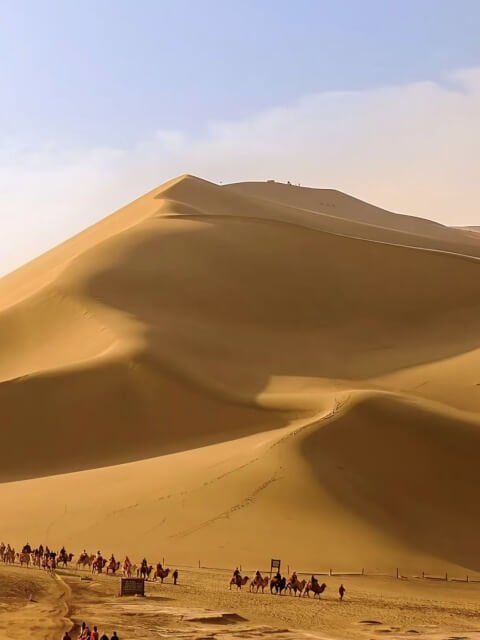
*Silk Road – Great Sand Desert.
In 1877, German geologist and geographer Ferdinand von Richthofen coined the term “Silk Road” in his book China, referring to the trade route that facilitated silk trade between China and Central Asia and India from 114 BCE to 127 CE. The term quickly gained acceptance in academic and popular circles and became widely used. The “Maritime Silk Road,” on the other hand, was an ancient maritime trade and cultural exchange route between China and foreign countries.
Centered on the South China Sea, it was also known as the “South China Sea Silk Road.” It emerged during the Qin and Han dynasties, developed during the Three Kingdoms to Sui periods, and flourished during the Tang, Song, Yuan, and Ming dynasties. It is considered one of the oldest known maritime trade routes.
History of the Silk Road🏜️
The Hexi Corridor was a crucial passageway on the Silk Road. However, rather than having a “Silk Gate,” it featured the “Jade Gate.” This is because, 2000 years before the Silk Road was documented in historical texts, cultural exchanges between East and West were already taking place—not for the export of silk, but for the import of Hetian jade. In 1868, German geographer and geologist Ferdinand von Richthofen, funded by the California Bank in the United States, conducted research in China. After arriving in Shanghai, he was commissioned by the Shanghai Chamber of Commerce to undertake a comprehensive study of China’s geography and topography, traveling extensively throughout the country.
Although he planned to explore the Hexi Corridor in Gansu and Xinjiang after his investigation in Shaanxi, events such as the Hui uprisings in Shaanxi and Gansu and the invasion of Yakub Beg thwarted these plans. In 1870, Richthofen visited Henan, where he studied the silk and cotton markets in the southern district of Luoyang and visited the Shanxi-Shaanxi Guild Hall and Guandi Temple. After returning to Germany in 1872, he devoted himself to writing the five-volume China: Results of My Travels and Studies.
Before his death in October 1905, he completed and published volumes I, II, and IV. Volumes III and V were later edited and published by his students in 1912. In the first volume, published in Berlin in 1877, Richthofen coined the term “Silk Road” to describe the trade routes connecting Chang’an in China with Central Asia. In 1910, German scholar Hermann expanded on the concept of the Silk Road in his book The Ancient Silk Road Between China and Syria, providing further literary insights.
In 1915, his article The Silk Road from China to the Roman Empire proposed that the Silk Road served as a transportation route linking China with the Greco-Roman world. With new archaeological discoveries, Hermann extended the route to Asia Minor and the western Mediterranean, solidifying the Silk Road as a land trade route connecting China, Central Asia, South Asia, West Asia, Europe, and North Africa. Traditionally, the Silk Road began in the ancient Chinese capitals of Chang’an or Luoyang and extended through Central Asia, Afghanistan, Iran, Iraq, and Syria to the Mediterranean, with Rome as its endpoint.
Spanning 6,440 kilometers, it was a conduit for the exchange of civilizations between East and West on the Eurasian continent, with silk as its most iconic commodity. Over the centuries, nomads, merchants, missionaries, diplomats, soldiers, and scholars traversed the route. As time passed, the Silk Road became a collective term for all political, economic, and cultural exchanges between ancient China and the West.
These routes included the official Northwest Silk Road established by Zhang Qian during the Western Han Dynasty, the “Grassland Silk Road” through the Mongolian Plateau and northern Tian Shan, the rugged “Southwest Silk Road” connecting Chang’an, Chengdu, and India, and the “Maritime Silk Road” of the Ming Dynasty, linking Guangzhou, Quanzhou, Hangzhou, and Yangzhou to the South China Sea, the Arabian Sea, and even the eastern coast of Africa.
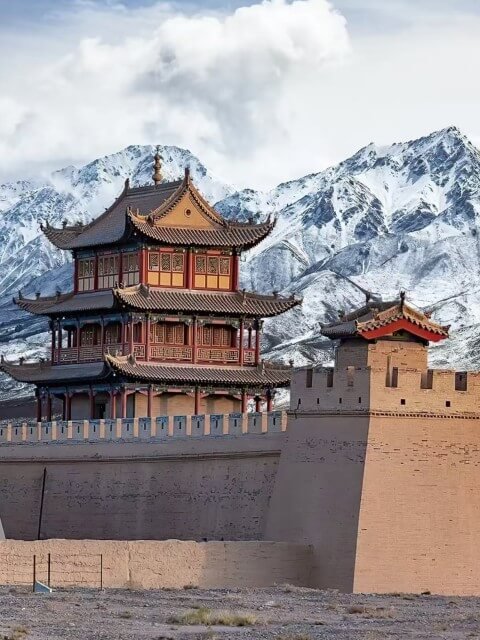
*Silk Road – Ancient Fortress.
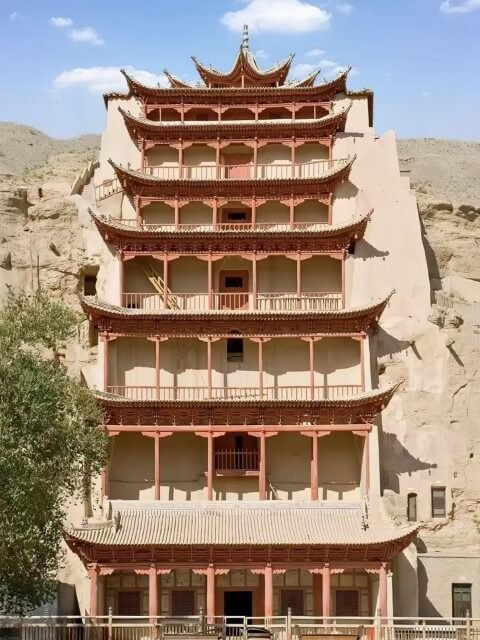
*Silk Road – Mogao Caves.
Western Han Dynasty🐴
Before the Qin Dynasty, routes facilitating exchanges between China and the West were already in existence. The formal westward transmission of silk began during the Western Han period, when the opening of the Western Regions under Zhang Qian laid the foundation for the Silk Road. During this era, the sources, destinations, and routes of silk trade became clear, well-documented, and traceable. The volume of silk trade was significant, with East and West engaging in planned and even organized trade, establishing the Silk Road during Emperor Wu of Han’s reign.
During the Western Han period, the area west of the Yang Pass and Yumenguan, including modern-day Xinjiang and beyond, was referred to as the Western Regions. In the early Han period, routes connecting East and West were obstructed by the Xiongnu. During Emperor Wu’s reign, China began to establish connections with the Western Regions, intensifying its governance there. The Western Regions initially comprised thirty-six states, which later fragmented into over fifty, situated west of the Xiongnu and south of Wusun.
When Emperor Wu heard that the migrating Yuezhi, displaced by the Xiongnu, sought revenge against them, he dispatched envoys to ally with the Yuezhi for a joint attack on the Xiongnu. Zhang Qian, a native of Hanzhong, Shaanxi, volunteered for the mission. In 139 BCE, Zhang led over 100 men westward, but they were captured by the Xiongnu and detained for ten years. Eventually escaping, Zhang journeyed westward for several weeks and reached Dayuan. However, the Yuezhi had lost interest in attacking the Xiongnu and continued their westward migration.
Zhang stayed in the Western Regions for over a year before returning east. Captured again by the Xiongnu on his way back, Zhang remained in detention for over a year before escaping amidst internal chaos following the death of the Xiongnu leader. In 126 BCE, he returned to Han China, where Emperor Wu warmly received him and granted him the title of Grand Messenger. Although Zhang’s initial mission failed, his journey yielded valuable information about the Western Regions. Historian Sima Qian described his expedition as “opening the way.”
After Zhang Qian’s return, Emperor Wu sent envoys to explore a route to Daxia that avoided the Xiongnu but to no avail. Later, Han forces defeated the Xiongnu and secured the Hexi Corridor, opening a direct passage between the Han Dynasty and the Western Regions. Following Huo Qubing’s decisive victory over the Xiongnu at Qilian Mountain, Zhang Qian proposed forming an alliance with Wusun to weaken the Xiongnu. In 119 BCE, Zhang undertook a second mission to the Western Regions to invite Wusun back to their ancestral lands and establish connections with various Western states.
Although Zhang did not achieve his primary goal, his emissaries reached several countries, paving the way for frequent exchanges between the Han Dynasty and the northwest. This marked the official opening of the Silk Road. Emperor Wu conferred upon Zhang Qian the title of Marquis of Bowang in recognition of his contributions.
Eastern Han Dynasty🐎
In the 16th year of Yongping (73 CE), Ban Chao accompanied General Dou Gu on a campaign against the northern Xiongnu and was subsequently tasked with an envoy mission to the Western Regions. Leading a team of 36 officers and soldiers, he first arrived at Shanshan. With the resolve that “one cannot catch the tiger cub without entering the tiger’s den,” Ban Chao intimidated the rulers of Shanshan into submission. He then persuaded Khotan to align with the central government. Ban Chao reopened the Silk Road, which had been cut off for 58 years, and helped free the Western Regions from Xiongnu control.
He was appointed Protector General of the Western Regions and managed the area for over three decades, strengthening ties between the Western Regions and the Chinese heartland. In the third year of Yongyuan (91 CE), the northern regions of Kucha, Karashahr, and Aksu submitted to the Eastern Han. Ban Chao established the Protectorate of the Western Regions in the city of Taqian in Kucha and personally oversaw the northern routes while deploying Chief Clerk Xu Gan to Shule to coordinate with the northern route.
In the sixth year of Yongyuan (94 CE), Ban Chao mobilized an army of over 70,000 from eight kingdoms, including Kucha and Shanshan, to suppress the rulers of Yanqi and other states resisting the central government. Over 50 kingdoms in the Western Regions subsequently came under Han rule. In the ninth year of Yongyuan (97 CE), Ban Chao dispatched his deputy Gan Ying on a mission to the Roman Empire. Gan Ying reached the Persian Gulf and observed the vast ocean but was discouraged from crossing it by local Persian merchants.
Wei and Jin Dynasties🥻
During the Wei and Jin Dynasties, the Silk Road continued to develop and diversified into three main routes: the Northwest Silk Road (also called the Oasis or Desert Silk Road), the Southwest Silk Road, and the Maritime Silk Road. This period was characterized by its transitional nature from the Han to the Sui and Tang dynasties, the expanded significance of the Maritime Silk Road, and frequent exchanges between the northern and southern regimes with the Western Regions.
In the first year of Tai’an (455 CE) during the Northern Wei Dynasty, Persia reestablished direct contact with the Northern Wei after a long interruption. Between this year and the third year of Zhengguang (522 CE), the Book of Wei recorded ten Persian missions. The first five missions arrived at Pingcheng (modern Datong, Shanxi), bringing glassmaking techniques to China, while the latter five traveled to Luoyang after the Northern Wei court relocated there in 493 CE.
In the first year of Shengui (518 CE), Song Yun and the monk Huisheng departed from Luoyang along the Silk Road to visit the Western Regions and obtain Buddhist scriptures. In the third year of Zhengguang (522 CE), they returned with 170 volumes of Mahayana Buddhist texts, enriching China’s Buddhist culture. Persian envoys also traveled to the Southern Dynasties via the Silk Road. In the second year of Zhongdatong (530 CE), Persia sent an envoy with a Buddha’s tooth as a gift.
Sui Dynasty🪵
In the ninth year of Kaihuang (589 CE), the Sui Dynasty unified China, ending centuries of division. During this period, the emerging Turkic tribes occupied vast territories in the Western Regions extending to the Caspian Sea, and the Tuyuhun frequently harassed the Hexi Corridor. Official and civilian interactions between China and the Western Regions, as well as the West, faced obstacles. However, relations with various Silk Road nations and peoples grew increasingly close.
Many Western Region merchants traded in Zhangye, and Emperor Yang of Sui appointed Pei Ju to oversee these activities. Pei Ju used generous gifts to attract foreign traders to the Chinese heartland. According to the Book of Sui, Wei Jie, a Supervisory Censor, and Du Xingman, an official, were dispatched to the Western Regions, reaching places such as Kapisa (near modern Tashkent).
They brought back agate cups, Buddhist scriptures from India, performers skilled in song and dance, and rare items like lion pelts and fire-resistant mouse fur. These interactions revitalized official and civilian exchanges.

*Silk Road – Desert Route.
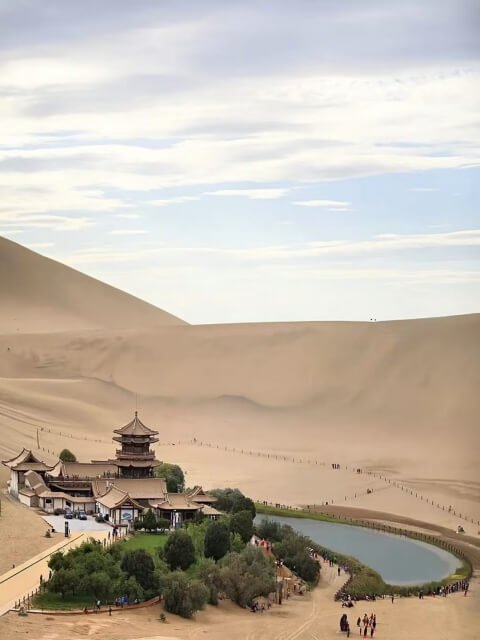
*Silk Road – Crescent Lake.
Tang Dynasty🪭
The Tang Dynasty marked the golden age of the Silk Road, following the establishment of a powerful empire after the Sui Dynasty. Emperor Taizong, Li Shimin, defeated the Eastern Turkic Khaganate and Tuyuhun, securing control over the northern and southern steppes. Emperor Gaozong, Li Zhi, later vanquished the Western Turkic Khaganate, establishing the Anxi and Beiting Protectorates. The Tang Empire stretched from the coasts of Korea in the east to the Amu Darya River (or possibly the Tigris River) in the west, making it the most advanced and powerful nation of its time, with world-leading economic and cultural development.
Through the Silk Road, the East and the West engaged in official and private exchanges, using the Arab Empire as a vital bridge. Numerous routes branched off the main road in the eastern segment, connecting regions north and south of the desert and various Western Regions, collectively referred to as the “Heavenly Khagan Roads” (named after Emperor Taizong). Delegates from the Arab Empire and the Byzantine Empire regularly visited Chang’an. Landmarks like Dunhuang, Yangguan, and Yumenguan became bustling “land harbors” of the time.
Maritime routes also flourished. Chinese ships traveled to regions like Linyi (southern Vietnam), Zhenla (Cambodia), Heling (Java), and Pyu (Myanmar), reaching India, the Arab world, and Europe. Ports like Guangzhou, Quanzhou, and Liujiagang (near modern-day Wusongkou, Shanghai) emerged as significant hubs. Historical records describe Guangzhou’s docks filled with ships from various nations, including Persia and Southeast Asia, facilitating vibrant trade.
The thriving Silk Road fostered profound cultural and intellectual exchanges between the East and West, influencing social and ideological development. Religion played a significant role in these exchanges. Buddhism, introduced during the Western Han Dynasty, flourished during the Tang. Eminent monk Xuanzang traveled along the Silk Road to India for sixteen years, studying and documenting the politics, society, and customs of the time in his Great Tang Records on the Western Regions, which remains a critical resource for studying medieval India.
He brought back 657 Buddhist scriptures, and Emperor Gaozong built the Giant Wild Goose Pagoda in Chang’an for their preservation and translation. Another monk, Yijing, traveled by sea to India and returned with 400 scriptures, contributing to works that detailed the culture and life in South Asia.
Song and Yuan Dynasties💒
During the Northern Song, territorial control diminished significantly, with the government unable to secure the Hexi Corridor. By the Southern Song, engagement in the northwest became nearly impossible, and the Silk Road declined further as maritime trade routes rose to prominence. Under the Yuan Dynasty, Mongol conquests expanded the empire’s territory and restored the Eurasian trade network. The establishment of postal relay systems facilitated long-distance trade across the vast Eurasian landmass.
European, West Asian, Central Asian, and Chinese merchants traded goods like gold, silver, jewels, spices, textiles, silk, tea, and ceramics. Historical accounts, including The Travels of Marco Polo, describe bustling international trade hubs such as the Yuan capital, Dadu (Beijing), and Kashgar. These cities were vibrant centers of commerce, drawing merchants from across the world. While trade flourished during the Yuan era, cultural and religious missions became increasingly significant, reflecting the Silk Road’s gradual shift from commerce to cultural exchange and its eventual decline.
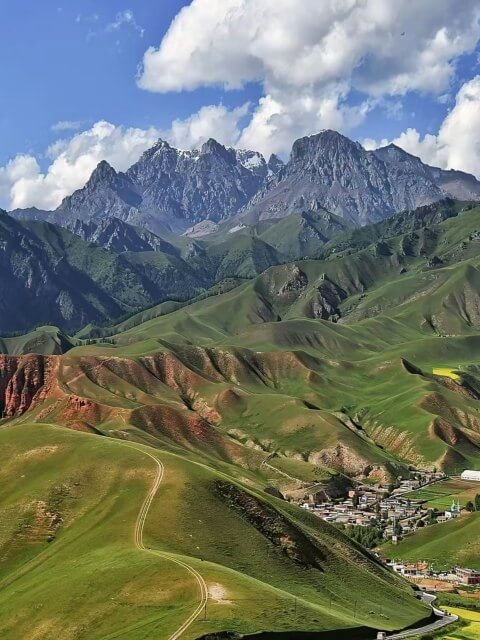
*Silk Road – Aerial View.
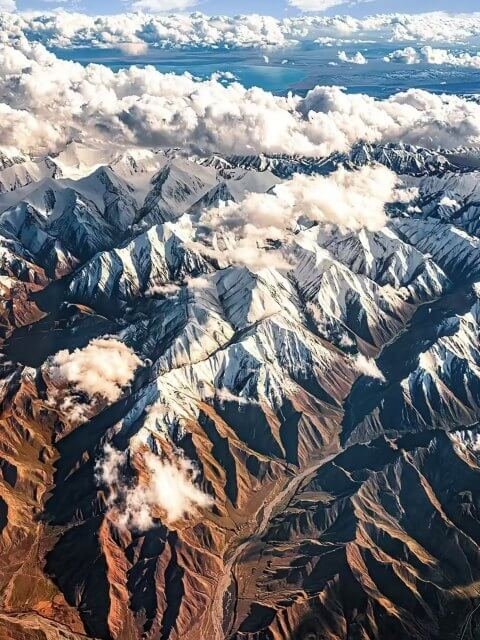
*Silk Road – Crossing Mountains and Valleys.
Ming Dynasty⛺
A mid-Ming Dynasty map, The Mountain and River Map of the Silk Road, meticulously depicted over 200 locations along the Silk Road using elegant landscape artistry. The map traced the route from Jiayuguan to the west, highlighting the Ming-era Silk Road’s pathways. The maritime Silk Road of the Ming Dynasty centered around three main ports: Guangzhou, Quanzhou, and Ningbo, supported by auxiliary ports.
In 2017, China’s National Cultural Heritage Administration designated Guangzhou as the leading city for preserving and applying for World Heritage status for the Ming maritime Silk Road, in collaboration with cities like Nanjing, Ningbo, and Fuzhou. In the Qing Dynasty, the government’s isolationist policies, coupled with advancements in shipbuilding and navigation, shifted trade from land to sea routes, leading to the Silk Road’s ultimate decline.
Successful World Heritage Designation🎍
On June 22, 2014, at the 38th World Heritage Committee meeting held in Doha, Qatar, the joint nomination by China, Kazakhstan, and Kyrgyzstan for the eastern section of the ancient Silk Road, titled “Silk Roads: the Routes Network of Chang’an-Tianshan Corridor”, was officially inscribed as a UNESCO World Cultural Heritage site. This marked the first successful transnational cooperative World Heritage designation. This 5,000-kilometer network represents a segment of the broader Silk Road, stretching from the ancient Chinese capitals of Chang’an and Luoyang to the Zhetysu region of Central Asia.
Established between the 2nd century BCE and the 1st century CE, the Silk Road remained in use until the 16th century. It connected diverse civilizations, significantly advancing trade, the exchange of religious beliefs, the dissemination of scientific knowledge, technological innovation, and the practice of cultural arts. The heritage includes 33 sites encompassing ancient capitals, palace complexes, trading settlements, Buddhist caves and temples, ancient roads, postal stations, passes, beacon towers, segments of the Great Wall, fortifications, ancient tombs, and religious structures from various dynasties and khanates.
At the same meeting, UNESCO also approved the inscription of China’s Grand Canal project and the Silk Road project jointly nominated by China, Kazakhstan, and Kyrgyzstan into the World Heritage List. These became China’s 32nd and 33rd World Cultural Heritage sites, with the Silk Road marking the nation’s first transnational joint nomination.