


694x469-300x203.png)
Zhangjiajie National Forest Park: A Natural Wonder
Zhangjiajie National Forest Park Overview⛰️
Zhangjiajie National Forest Park is located at No. 279, Jinjian Road, Wulingyuan District, Zhangjiajie City. The park covers an area of 48.1 square kilometers and, together with the adjacent natural reserves of Suoxiyu, Tianzi Mountain, and Yangjiajie, forms the Wulingyuan Scenic Area. It is situated in the central part of the Wuling Mountains and is the core scenic area of Zhangjiajie.
Zhangjiajie’s landform is a unique type of sandstone landscape formed primarily from quartz sandstone from the Middle and Late Devonian periods. The scenery is shaped by the forces of erosion, gravity collapse, and weathering, resulting in towering, angular, and straight-edged stone pillar forests. The region enjoys a subtropical monsoon humid climate with an average annual temperature of 17°C. The natural beauty is characterized by peculiar peaks, tranquil valleys, and elegant forests.
There are over 3,000 unique peaks, resembling animals, humans, and objects in vivid and grand forms, earning the area the nickname “Three Thousand Peaks and Eight Hundred Streams.” Major scenic spots include Huangshizhai, Jinbian Stream, Yuanjiajie, and Yangjiajie. In August 1988, Zhangjiajie National Forest Park was listed as a national key scenic area. In December 1992, its remarkable quartz sandstone peaks were included in the UNESCO World Natural Heritage list.
In February 2004, it was designated as a World Geopark, and in 2007, it became one of China’s first 5A-level tourist attractions. From January to July 2024, the total number of visitors to the Zhangjiajie Wulingyuan Scenic Area (including Zhangjiajie National Forest Park) exceeded 4.04 million.
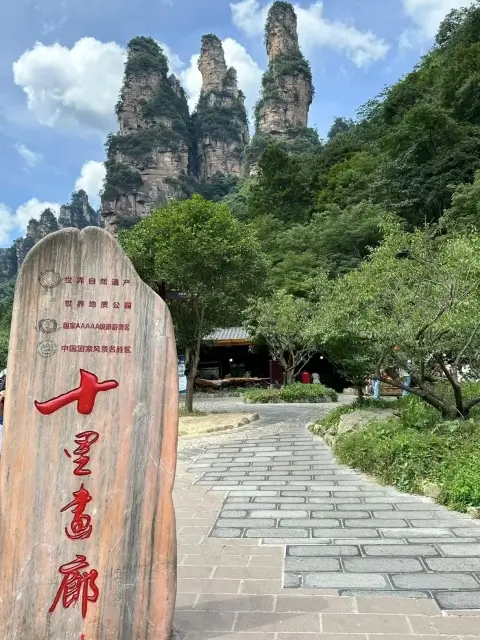
*Zhangjiajie National Forest Park Ten-Mile Gallery.
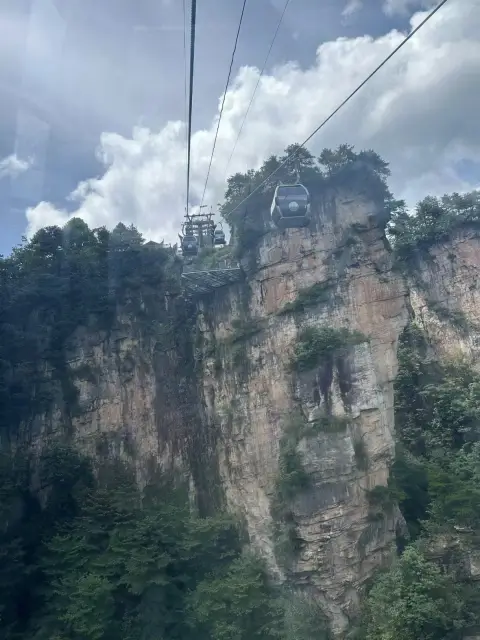
*Zhangjiajie National Forest Park Mountain Cable Car.
The Origin of the Name "Zhangjiajie"🍃
According to the preface written by Zhang Zaichang in the “Zhang Family Genealogy” during the fourth year of the Chongzhen reign (1631), the land now known as Zhangjiajie National Forest Park was granted to Zhang Wancang, a military officer stationed at Yongding Wei (Daying) during the Hongzhi period of the Ming Dynasty (1488–1506). The imperial court awarded this mountainous forest area as a reward for his achievements. Zhang Wancang’s great-great-grandson, Zhang Zaihong, was granted the title of a military officer by the court and established a local government office in Zhangjiajie.
Since then, the area became a hereditary domain of the Zhang family, giving rise to the name “Zhangjiajie.” Over time, descendants of the Zhang family maintained and developed the region, and Zhangjiajie National Forest Park was once home to vast primitive secondary forests. In 1958, it was designated as Zhangjiajie Forest Farm. In September 1982, the State Planning Commission officially named it Zhangjiajie National Forest Park.
Terrain and Geography🗺️
Zhangjiajie City is located between 28°52′—29°48′N latitude and 109°40′—111°20′E longitude, in the northwest part of Hunan Province, China. It borders Hubei Province to the north and lies in the eastern section of the Wuling Mountains. The city is predominantly mountainous, with the terrain sloping from northwest to southeast. The highest point is Doufeng Mountain in the northwest of Sangzhi County, with an elevation of 1,890 meters. The total area of the city is 9,518 square kilometers, consisting of 2 urban districts and 2 counties, with the municipal government located in Yongding District.
The landform of Zhangjiajie is a special type of sandstone landscape. Situated in the South China tectonic plate and the subtropical humid zone, it is primarily made up of nearly horizontal Middle and Devonian quartz sandstones. Erosion, gravity collapse, and weathering have shaped this landscape into tall, angular, and straight-edged stone pillar forests. A variety of landscape types have formed under the influence of these forces, including platforms, mesas, stone walls, stone columns, natural bridges, and remnants of forests.
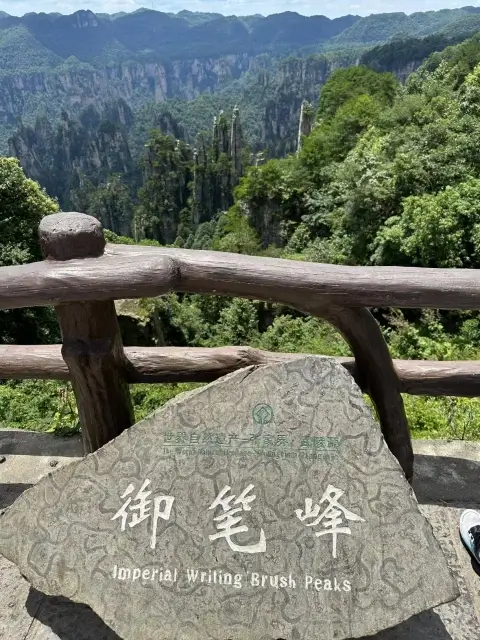
*Zhangjiajie National Forest park imperial writing brush peaks.
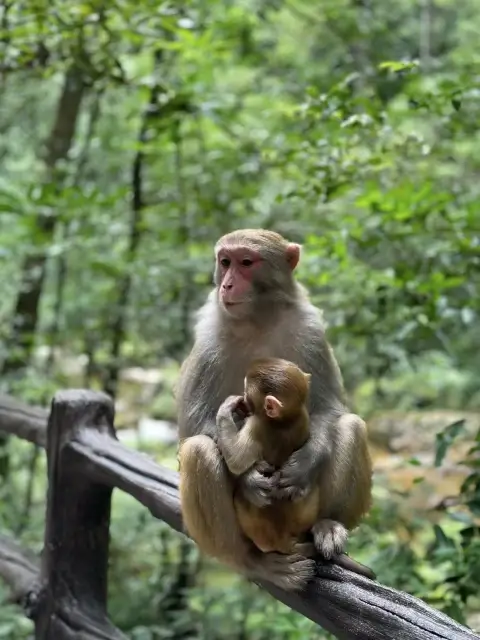
* Zhangjiajie National Forest Park Monkey Mother&baby.
Scenic Area Layout🚩
Tianzi Mountain – Yuanjiajie – Ten-Mile Gallery
Enter from the Wujiayu ticket station in Wulingyuan, take the eco-friendly bus to the lower station of the Tianzi Mountain Cableway, and ascend by cable car. Visit attractions such as Helong Park, Yubi Peak, Fairy Offering Flowers, and Xihai. Lunch options include fast food or bringing your own food at Tianzi Mountain. After lunch, take the eco-friendly bus to Yuanjiajie Scenic Area to explore the First Bridge Under Heaven, Hallelujah Mountain, the Back Garden, and the Maze Platform. Descend via the Bailong Elevator, and choose either to visit Jinbian Stream upstream or Ten-Mile Gallery downstream. Stay in Wulingyuan and enjoy the Charm of Xiangxi performance in the evening.
Huangshizhai – Jinbian Stream
Enter from the Forest Park ticket station, and either hike (1.5–2 hours) or take the cable car to Huangshizhai, the highest observation platform in the park. Visit the Six Wonders Pavilion, Palm Peak, Star Gazing Platform, and Sky Bridge Ruins. For lunch, enjoy fast food or bring your own food at the top of Huangshizhai. In the afternoon, hike Jinbian Stream (7.5 kilometers, approximately 2 hours) to visit Jinbian Rock, Zicao Pool, Thousand-Mile Reunion, and Water-Round Gate. Take the eco-friendly bus back to the Wujiayu ticket station in Wulingyuan, stay in Wulingyuan, and watch the Charm of Xiangxi performance in the evening.
Key Attractions🏖️
Yuanjiajie🌴
Yuanjiajie is located on the northern foothills of Sandao Gorge, primarily made up of quartzite. It is a concentrated scenic area in Zhangjiajie national forest Park. You can reach Yuanjiajie from the left side of Zicao Pool along Jinbian Stream, or follow the edge of the Yuanjiajie Plateau and take a small path to descend to the meeting point of Jinbian Stream. You can also travel from Yuanjiajie to Tianzi Mountain or Yangjiajie. From Sandao Gorge, you can travel along the cliff edge to reach Zhongping, home to the “First Bridge Under Heaven.” This stone bridge is only 3 meters wide, 5 meters thick, and spans about 50 meters with a relative height of nearly 400 meters.
The First Bridge Under Heaven and the Husband and Wife Rocks are jointly known as the “Twin Wonders of Zhangjiajie.” Tianzi Mountain got its name from the leader of the peasant uprising in the early Ming Dynasty, who styled himself “King Tianzi” (Heavenly King). Tianzi Mountain lies east of Suoxi Gorge, south of Zhangjiajie, and north of Sangzhi County, making it one of the four major scenic spots in the Wulingyuan area. It is located at the highest point of the “Golden Triangle,” with the highest peak at 1262.5 meters (Kunlun Peak) and the lowest at 534 meters (Shilan Gorge).
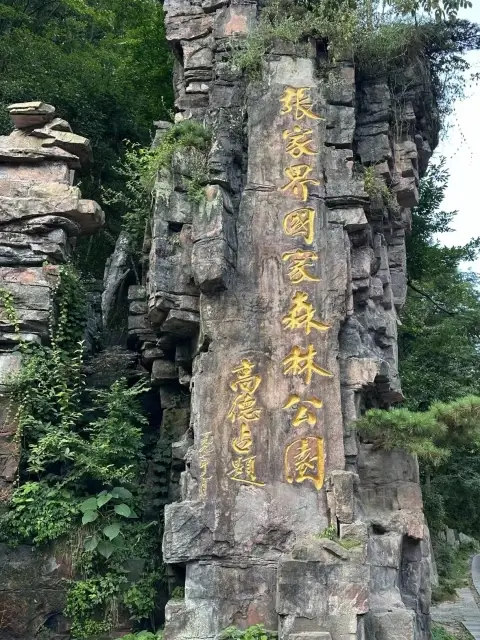
*Zhangjiajie National Forest Park Chinese Character Stone Carvings.
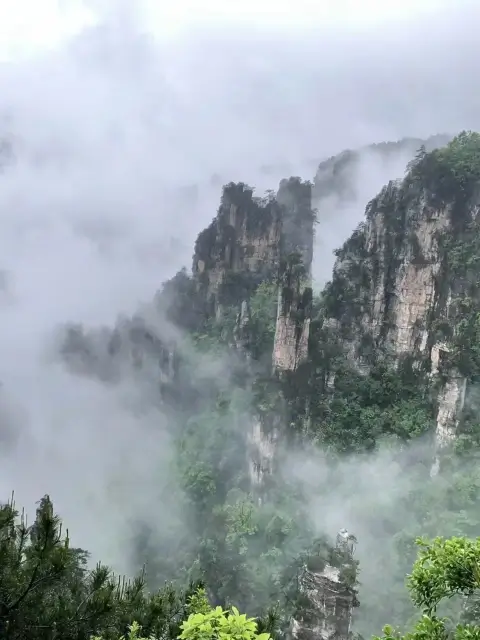
* Zhangjiajie National Forest Park Misty Forest.
Jinbian Stream🌊
Jinbian Stream is the core attraction of Zhangjiajie National Forest Park, named after Jinbian Rock that it flows through. The stream is 5710 meters long, and its surroundings are considered some of the most beautiful in Wulingyuan. Entering from the Zhangjiajie National Forest Park gate, walk about 300 meters to reach the entrance to Jinbian Stream. Major highlights include Zui Luohan, the Divine Eagle Protecting the Whip, Jinbian Rock, Huaguo Mountain, Water Curtain Cave, Splitting the Mountain to Save the Mother, Thousand-Mile Reunion, Nanmu Ping, and Water-Round Gate.
Yangjiajie🦋
Located in the northwest of the Wulingyuan Scenic Area, Yangjiajie connects to Zhangjiajie in the east and Tianzi Mountain to the north. The area covers 3400 hectares, with three touring zones: Xiangzhi Creek, Longquan Gorge, and Baimonkey Valley, offering over 200 scenic spots. The area is accessible via a road 43 kilometers from Zhangjiajie City. The landscape features quartz sandstone peaks and canyon terrain, with the highest peak, Yibu Deng Tian, reaching 1130 meters. The area is densely vegetated, with a forest coverage rate of 95%.
The developed Xiangzhi Creek and Longquan Gorge both have 2.5 kilometers of vehicle-accessible paths. Yangjiajie is known for its more than 200 scenic spots, with the famous Longquan Waterfall, called the “World’s First Wonderful Waterfall.” According to legend, the Northern Song dynasty’s Yang family generals camped here while suppressing the Heavenly King, who styled himself as King Tianzi. After the long war, the Yang family settled here, and the area became known as “Yangjiajie.”
Wulongzhai🐉
Wulongzhai, one of the most perilous spots in the Yangjiajie Scenic Area, can be reached by crawling through caves, walking along cliff seams, or scaling rocky paths. The fortress is 300 meters high and surrounded by sheer stone walls, with only a narrow 1000-meter path leading to the top. Along this path are several natural barriers, including some sections under one meter wide, allowing only one person to pass at a time. After passing a horizontal path and crawling through a rocky cave, you’ll encounter a narrow 30-meter long passageway that’s only half a meter wide, requiring visitors to walk sideways to get through. At the summit, a narrow stone crack between two mountains serves as the route to the northeast peak, bordered by vertical stone walls several meters high.
Yaozi Zhai🌲
Yaozi Zhai covers an area of 12 square kilometers and is a creative base for the Zhangjiajie Photography Association. It is a popular route for European and American teams and independent travelers. Also known as Jiegong Mountain, it is located southeast of the Forest Park, 5 kilometers from Laomo Bay. It gets its name from its kidney-like shape. At an elevation of 1050 meters, the summit is a narrow ridge, about 1400 meters long and 100 meters wide, offering a panoramic view with steep cliffs on three sides. Known for its dramatic landscapes, it features major sights such as the Sky Bridge and Layered Stone Tower.
Echo Valley🍂
Echo Valley is located at the end of the mountain road leading to Yaozi Zhai. The cliffs on either side of the valley rise over 200 meters. When you shout from the bottom of the valley, the sound echoes back loudly and clearly from the top. If you call out from the top, the sound travels down to the bottom and reverberates across the mountains on either side, with the sound resembling a booming bell and lingering for a long time.
Sobi Rock🪨
Sobi Rock is located about 50 meters east of Echo Valley, nestled in a narrow mountain peak. The rock’s tip is about 5 meters long, cone-shaped, like a spearhead. Below the tip, a small round section resembles a long handle, and where the tip and handle meet, the rock appears to be wrapped with a natural band. The area is overgrown with small bushes, adding to its unique charm.
Monkey Mountain Park🐒
Zhangjiajie National Forest Park has effectively protected its wildlife, leading to a rapid increase in the number of macaques. Currently, there are about 22 groups of monkeys, totaling over 1000. To meet the tourists’ interest in interacting with the monkeys, a special habitat for them was created near the park entrance in 1992. Every day, hundreds of monkeys gather here, providing visitors with a unique experience.
Tujia Folk Culture Park🪺
Located in Zhangjiajie City, the Tujia Folk Culture Park blends cultural and natural attractions. It is a large, comprehensive tourism service area that includes sightseeing, performances, rare exhibits, accommodation, dining, entertainment, and shopping. The park consists of various sections, including traditional Tujia architecture, folk customs displays, art performances, guest rooms, restaurants, a large hunting ground, a rare plant garden, and a root carving base. Notable attractions include the Tusi Castle, Baishou Hall, Tujia Village, and the Houwang Palace. The Chongtian Tower, built into the mountainside, stands 48 meters tall, with 9 floors and 12 tiers, offering a magnificent view and a unique architectural design.
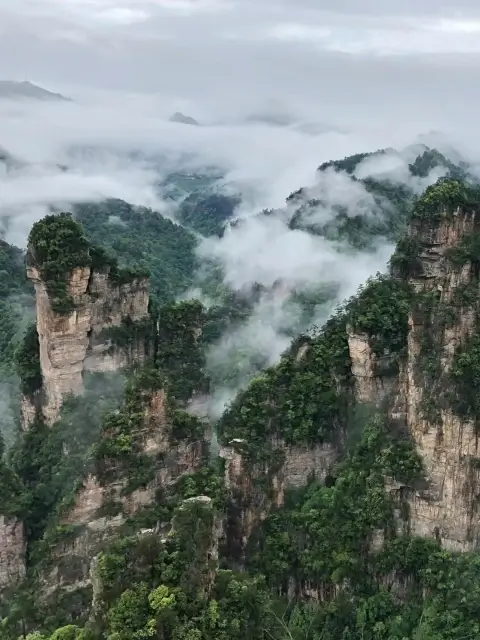
*Zhangjiajie National Forest Park Majestic Mountains.
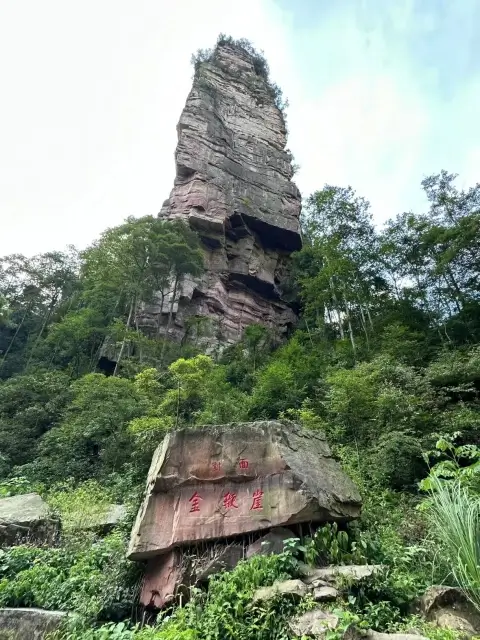
* Zhangjiajie National Forest Park Golden Whip Cliff.
Maoyan River Drift🍁
The Maoyan River Drift is located in the Maoyan River Scenic Area, downstream from the Pinghu section, 32 kilometers west of Zhangjiajie City. The drift stretches for 28 kilometers with a drop of 66 meters and features 55 river beaches. This drift is considered the largest and safest of its kind in China, and it is one of the most thrilling tourism activities in Zhangjiajie.
Longwang Cave🕳️
Longwang Cave, located 10 kilometers east of the Wulingyuan Scenic Area, is considered one of the largest and oldest karst caves in China. It is praised as a “natural wonder” by speleologists and is one of Zhangjiajie National Forest Park’s key tourist destinations. With a total length of about 30 kilometers, an average height of 50 meters, and a width of 80 meters, the cave features 58 chambers, 28 stone corridors, 15 pearl waterfalls, 3 underground rivers, 2 lakes, and 45 water pools. The cave is also home to the “World’s First Pillar,” a massive stone column called the Longwang Treasure Pillar.
Grand Canyon🦦
The Zhangjiajie Grand Canyon, located in San Guan Si Township, Cili County, is adjacent to the Wulingyuan Scenic Area. It is a newly developed tourism spot and was formerly known as “Lanchuan Gorge” or “Luanchuan Gorge.”
Development and Conservation🌸
Zhangjiajie National Forest Park strictly manages its scenic areas, ensuring rational development and utilization while maximizing the protection of heritage resources. The park has implemented detailed plans for the protection of its peak forest and limestone caves, ancient trees, rare and endangered plants, wildlife, forest fire prevention, pest control, and environmental conservation. Specific zoning plans have been developed for the surrounding protection areas, the construction of the Gao Yun section, and the renovation of the park’s stalls and stands, all aimed at safeguarding the resources of Zhangjiajie National Forest Park.
For ongoing projects, the principles of “localization, ecological balance, and high quality” are followed. All construction projects are required to coordinate with the surrounding landscape and the overall environment of the World Heritage site. Pollution prevention facilities must be designed, constructed, and put into operation simultaneously with the main projects, in accordance with the environmental protection standards of the heritage site. Any projects that fail to meet the environmental protection requirements must be rectified within a specified period; otherwise, they will not be allowed to proceed or be used.
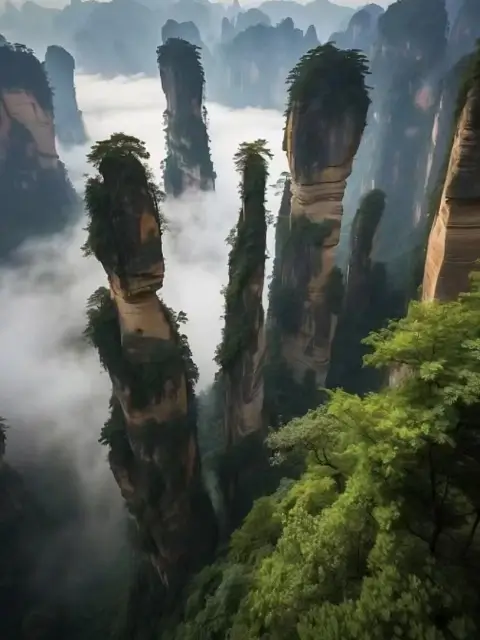
*Zhangjiajie National Forest Park Nature’s Masterpiece.
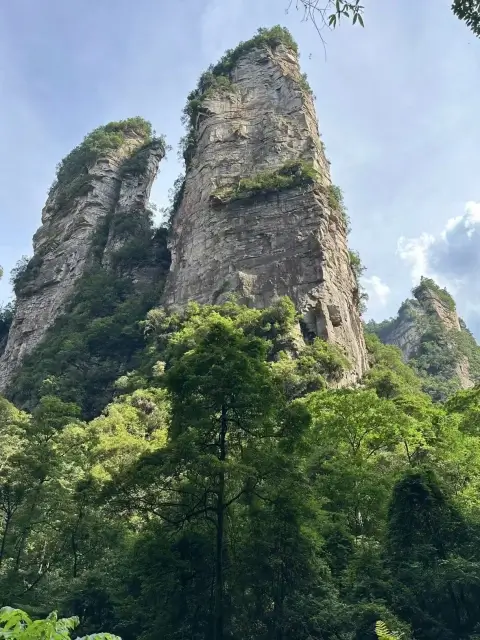
* Zhangjiajie National Forest Park Twin Peaks Standing Tall.
Value and Significance🌈
The natural beauty, form, artistic conception, and symbolic meaning of Zhangjiajie’s geological and landform landscapes not only inspire creativity and research among scholars and writers but also enhance the public’s reverence for nature and promote reflections on the harmonious coexistence between humans and the environment. The Zhangjiajie World Geopark has largely preserved its ecological environment and ecosystems in their near-original state, boasting rich biodiversity. It is a gene reservoir of global significance for biodiversity and plays a crucial role in the study of biological evolution, ecological diversity, and the harmonious development of human-environment relationships.
The geological and landform landscapes serve as important bases for geological and geographical popular science education and world-class natural tourist and leisure destinations. They represent a precious natural heritage for both Zhangjiajie and all of humanity. Zhangjiajie World Geopark also chronicles the 600-million-year geological development and evolution of the northwestern Xiangxi region, offering significant scientific insights into the region’s sedimentary paleogeographic environment and changes between land and sea.